The exact words
The poem
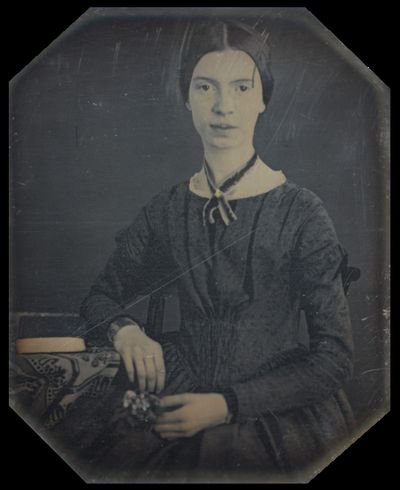
Emily Dickinson wrote “‘Hope’ is the thing with feathers” around 1861, while living quietly in her family’s house in Amherst, Massachusetts. It is only twelve lines long, three short stanzas built around a single image: hope as a small bird that lives inside a person.
The first stanza introduces the bird: “‘Hope’ is the thing with feathers – / That perches in the soul – / And sings the tune without the words – / And never stops – at all –.” Hope does not need words or reasons; it simply sings, constantly. The second stanza tests it in a storm. Its song is “sweetest” in a gale, and it would take a terrible storm to “abash the little Bird / That kept so many warm.”
What it means
The last stanza is the heart of the poem. “I’ve heard it in the chillest land – / And on the strangest Sea – / Yet – never – in Extremity, / It asked a crumb – of me.” Dickinson has felt hope in the coldest, most unfamiliar places, and it has never asked anything of her, not even a crumb, even when she was at her lowest. Hope gives and gives, and asks for nothing.
That makes the poem quietly tough rather than cheerful. It does not promise that the storm will pass. It says hope keeps singing anyway, which is why the poem is so often read in hard times, at memorials and in hospitals.
Dickinson’s dashes
Dickinson published almost nothing in her lifetime. After her death in 1886, her sister found nearly 1,800 poems, and early editors smoothed out her distinctive dashes and capital letters to make them look conventional. The version printed in 1891 reads more like ordinary punctuated verse. Modern editions, starting with Thomas H. Johnson’s in 1955, restore her dashes, which give the poem its breathless, hesitant music. When you read it aloud, let each dash be a small pause.
How to use it
The poem is short enough to read in full at a funeral or memorial, about thirty seconds. The first stanza alone works in a card or a speech. For a graduation, the “chillest land” and “strangest sea” make a good send-off for people heading somewhere new.
What people get wrong
A cheerful poem saying everything will be fine.
The poem is about hope surviving in the worst conditions, “in the chillest land” and “on the strangest sea.” Its comfort is that hope keeps singing even when things are not fine.
Timeline
- c. 1861Dickinson writes the poem in Amherst, in one of the most productive periods of her life.
- 1886Dickinson dies. Her sister Lavinia finds nearly 1,800 poems in her room.
- 1891The poem is published in Poems, Second Series, edited by Mabel Loomis Todd and Thomas Wentworth Higginson, with her dashes regularized.
- 1955Thomas H. Johnson's edition restores Dickinson's original dashes and capitals.
Use it in a speech
Questions people ask
What does “Hope is the thing with feathers” mean?
Dickinson compares hope to a small bird living in the soul. It sings constantly, keeps people warm in the worst storms, and never asks for anything back.
When was it written?
Around 1861. Like most of her poems, it was published only after her death, first in 1891.
Why does “Hope” have quotation marks?
Dickinson put the word in quotation marks in her manuscript, as if defining a term: “Hope” is the thing with feathers.
What is the last stanza about?
“Yet – never – in Extremity, / It asked a crumb – of me.” Even in the hardest times, hope has never asked for anything in return.
Cite this quote
These cite the original source directly, so you can use them in an essay or paper. Always check your teacher's required style.