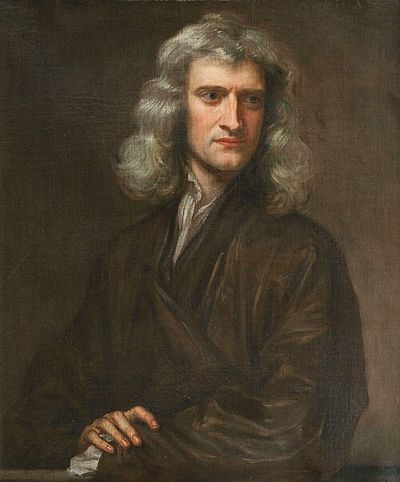
The exact words
The letter
By the mid-1670s Isaac Newton and Robert Hooke were rivals. Hooke, the Royal Society’s curator of experiments and a brilliant scientist himself, had criticized Newton’s 1672 paper on light and colors, and the two men had exchanged sharp words through intermediaries. In January 1676 Hooke wrote to Newton directly, proposing that they discuss their disagreements privately like gentlemen.
Newton replied on February 5. His letter is courteous. He praises Descartes’s work on light as “a good step,” says Hooke has “added much several ways,” and then writes the sentence that has made the letter famous: “If I have seen further it is by standing on the shoulders of Giants.” In England at the time the new year began in March, so the letter is dated 1675; by our calendar it is 1676.
An old image
Newton was not the first to use the image. In 1159, the English scholar John of Salisbury wrote that his teacher Bernard of Chartres used to say “we are like dwarfs sitting on the shoulders of giants,” able to see more and further than the ancients, not because our sight is sharper but because they lift us up. The saying was a commonplace among scholars by Newton’s day. The sociologist Robert K. Merton later wrote a whole book tracing its history.
Because the relationship between Newton and Hooke later became bitter, some writers have suggested the line was a sly insult aimed at Hooke, who was short and stooped. There is no evidence for this in the letter, and most historians read it as a sincere, if cautious, peace offering.
How to use it
The line is a perfect way to thank teachers, mentors and parents at a graduation or retirement. In writing, mention its medieval origin; it makes the point even better, since Newton was himself standing on the shoulders of earlier writers when he used it.
What people get wrong
Newton's own original image, a simple statement of humility.
The image was more than 500 years old. And the letter was part of a tense exchange with his rival Robert Hooke, so historians still debate how sincere it was.
Timeline
- 1159John of Salisbury writes that Bernard of Chartres compared his generation to dwarfs sitting on the shoulders of giants, seeing further thanks to those who came before.
- 1672Newton's paper on light and colors is published. Robert Hooke, the Royal Society's curator of experiments, criticizes it, starting a long rivalry.
- February 5, 1676Newton replies to a conciliatory letter from Hooke with the famous sentence. (The letter is dated 1675 in the old English calendar.)
- TodayThe phrase appears on the edge of the British £2 coin and names Google Scholar's motto, “Stand on the shoulders of giants.”
Use it in a speech
Questions people ask
Who said “If I have seen further it is by standing on the shoulders of giants”?
Isaac Newton, in a letter to Robert Hooke dated February 5, 1675 in the old calendar (1676 in ours).
Did Newton invent the phrase?
No. The image goes back at least to Bernard of Chartres in the twelfth century, as reported by John of Salisbury in 1159.
Was Newton mocking Hooke, who was short?
Some have suggested it, but there is no clear evidence. Most historians read the letter as a polite, if strained, attempt to make peace.
Cite this quote
These cite the original source directly, so you can use them in an essay or paper. Always check your teacher's required style.
Sources
- Isaac Newton to Robert Hooke, February 5, 1675/6. Manuscript, Historical Society of Pennsylvania.
- John of Salisbury, Metalogicon (1159), Book III, chapter 4.
- Robert K. Merton, On the Shoulders of Giants (1965).