The exact words
What happened in Akron in 1851
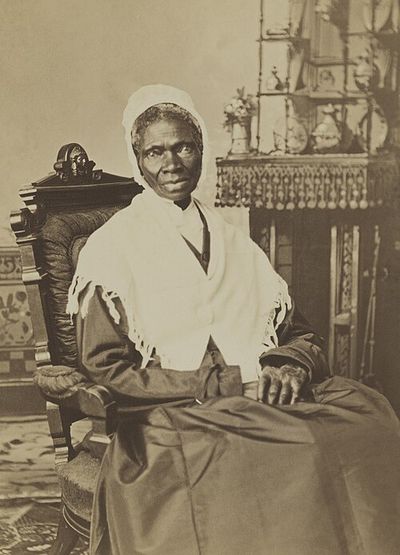
In May 1851 a women’s rights convention met in Akron, Ohio. Sojourner Truth, by then a well-known abolitionist preacher in her fifties, rose to speak. A local abolitionist and newspaper editor, Marius Robinson, was serving as the convention’s secretary, and a few weeks later he published her speech in the Anti-Slavery Bugle. In his version, Truth argues that she has as much muscle as any man and can do as much work, that women’s intellect deserves equal respect, that Jesus came into the world through a woman, and that men are “in a tight place” between women and the formerly enslaved, who are both demanding their rights.
It is a strong, witty speech, and it is the closest record we have of what she actually said. It does not contain the words “Ain’t I a woman?”
Where the famous version came from
Twelve years later, during the Civil War, the activist Frances Dana Gage, who had presided over the Akron convention, published her own account. Gage’s version is far more dramatic. Truth faces a hostile crowd, speaks in a heavy Southern dialect, repeats the question “Ar’n’t I a woman?” four times, and mentions having thirteen children sold into slavery. Truth, in fact, grew up in New York speaking Dutch, and she had five children. Gage seems to have written her account partly from memory and partly to give her readers a stirring scene.
Gage’s version spread because it is more memorable, and by the twentieth century it was the one in textbooks, often with the refrain modernized to “Ain’t I a woman?”
Why it matters
Truth could not write, so others recorded her words, and their choices shaped how she was remembered. Quoting the 1851 report restores her own plain, forceful voice. The refrain is still part of her story and of American history, and it is fine to use it, as long as you say where it comes from.
What people get wrong
A word-for-word transcript of Sojourner Truth's speech, spoken in Southern dialect.
A later retelling by Frances Dana Gage. Truth grew up in New York speaking Dutch, and the earliest report of her speech has no refrain at all.
Timeline
- May 29, 1851Sojourner Truth speaks at the Women's Rights Convention in Akron, Ohio.
- June 21, 1851Marius Robinson, who was at the convention, publishes a report of the speech in the Anti-Slavery Bugle. It does not contain the line “Ain't I a woman?”
- 1863The activist Frances Dana Gage publishes her own account, written in a heavy Southern dialect, with the repeated refrain “Ar'n't I a woman?”
- 20th centuryGage's version becomes the standard text, reprinted in schoolbooks and performed as “Ain't I a Woman?”
Use it in a speech
Questions people ask
Did Sojourner Truth say “Ain't I a woman?”
The phrase does not appear in the earliest report of her 1851 speech, published weeks later by Marius Robinson, who was present. It comes from a version written by Frances Dana Gage in 1863.
Why was the speech written in a Southern accent?
Gage wrote it in a stereotyped Southern Black dialect. Truth was born into slavery in New York, spoke Dutch as her first language, and did not speak that way.
Which version should I quote?
For accuracy, quote the 1851 Robinson report. If you quote “Ain't I a woman?”, say it comes from Gage's 1863 account.
Cite this quote
These cite the original source directly, so you can use them in an essay or paper. Always check your teacher's required style.
Sources
- Marius Robinson, report of the Akron convention, Anti-Slavery Bugle (Salem, Ohio), June 21, 1851. Library of Congress, Chronicling America.
- Frances Dana Gage, account of Sojourner Truth's speech, National Anti-Slavery Standard, May 2, 1863.
- The Sojourner Truth Project, comparison of the 1851 and 1863 texts.
- National Park Service, Sojourner Truth.