The exact words
An elegy for Lincoln
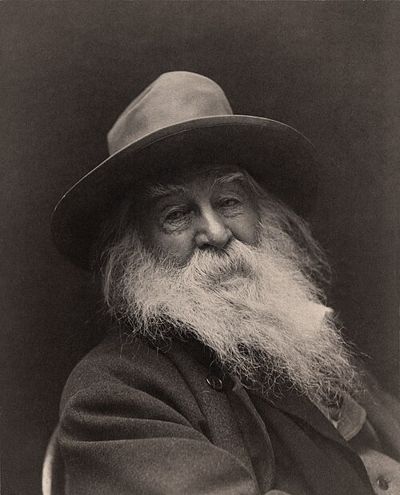
Walt Whitman had spent the Civil War in Washington, visiting wounded soldiers in hospitals, and he admired Abraham Lincoln from a distance. When Lincoln died on April 15, 1865, only days after Lee’s surrender, Whitman wrote several poems about the loss. “O Captain! My Captain!” appeared that year in the Sequel to Drum-Taps. The poem never names Lincoln. It tells a short story instead: a ship returns from a dangerous voyage, the harbor bells are ringing, crowds are cheering on the shore, and the captain who brought the ship through lies dead on the deck.
That contrast is the whole structure. The first lines announce victory: “our fearful trip is done,” the ship “has weather’d every rack,” “the prize we sought is won.” The next lines turn on a single word. “But O heart! heart! heart!” the speaker cries, and the poem lands on the dead captain, “fallen cold and dead.” Each stanza repeats the pattern, with the celebrations of the shore pulling against the speaker’s grief. In the last stanza the speaker says he walks the deck “with mournful tread” while the shores ring with bells.
What the images mean
The ship is the nation, and the long voyage is the war. The “prize we sought” can be read as the Union saved and the fighting ended. The speaker calls the captain “dear father,” which matches the way many Americans spoke of Lincoln, as the figure who held the country together. Whitman keeps the images simple on purpose. The speaker is an ordinary sailor, and the grief is personal, a man standing at the body rather than a poet commenting from a distance.
The form is also unusual for him. Most of Whitman’s poetry uses long, unrhymed lines. This poem rhymes and keeps a steady beat, closer to a song or hymn, and that may be a large part of why people memorized it so quickly.
How it is used today
The poem has become a shorthand for gratitude to a leader who is gone. Students have addressed it to teachers, most famously in the 1989 film Dead Poets Society, and it appears at funerals, memorials and retirement cards. When quoting it, remember what it was for: a death that came at the moment of victory. In a retirement toast the “prize won, port near” opening works well and the dead captain stanza does not. In a eulogy the reverse can be right. Either way, name Whitman and, if you can, say that the captain is Lincoln, since many listeners take the poem to be about a teacher or coach.
What people get wrong
A general poem about a beloved teacher or coach.
Whitman wrote it for Lincoln, though the poem never names him. The “captain” is the president, the “ship” is the nation, and the “fearful trip” is the Civil War.
Timeline
- April 9, 1865Lee surrenders at Appomattox, effectively ending the Civil War.
- April 15, 1865Abraham Lincoln dies the morning after being shot at Ford's Theatre in Washington.
- 1865Whitman publishes “O Captain! My Captain!” in his Sequel to Drum-Taps, the volume of poems about the war and Lincoln's death.
- 1989The film Dead Poets Society brings the poem to a new generation of readers.
Use it in a speech
Questions people ask
Who is the captain in “O Captain! My Captain!”?
Abraham Lincoln. Whitman wrote the poem after Lincoln's death in April 1865, though the text never says his name.
What does the ship represent?
The United States, brought through the Civil War. The “fearful trip” is the war, and the “prize we sought” is the Union preserved and the end of the fighting.
Was it Whitman's most popular poem?
It was one of the poems of his that readers knew best in his lifetime, and it is still the one most associated with Lincoln's death. It is also unusually regular in rhythm and rhyme for Whitman.
Cite this quote
These cite the original source directly, so you can use them in an essay or paper. Always check your teacher's required style.