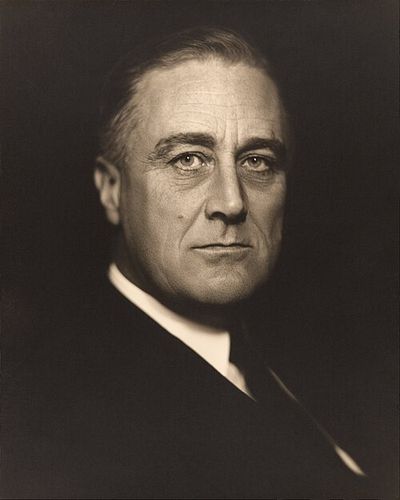
The exact words
What he meant in 1933
Roosevelt took office at the lowest point of the Great Depression. Around a quarter of American workers had no job, farm prices had collapsed, and in the weeks before the inauguration banks across the country were failing as frightened depositors rushed to pull out their savings. That rush was itself what kept knocking banks over, because no bank keeps all of its deposits in the vault. The fear was not just a feeling; it was part of the machinery of the crisis.
So when Roosevelt spoke of “nameless, unreasoning, unjustified terror,” he was not offering a general thought about bravery. He was asking people to stop the panic that was making everything worse, and he was promising action to replace it. The rest of the speech is a list of that action: putting people to work, helping farmers, supervising banks and investments. Two days later he closed every bank in the country for a “bank holiday”, and within days Congress passed emergency banking legislation so sound banks could reopen.
Why the line worked
The sentence comes very early in the address, almost as a first promise to the listeners. By naming fear as the enemy, Roosevelt gave a frightened country something it could actually fight, and he made calm itself sound like a patriotic act. Millions of people heard it live on the radio, which is a large part of why it stuck.
The idea was not new. Montaigne had written in the 1500s that fear was the thing he feared most, and Thoreau noted in 1851 that “nothing is so much to be feared as fear.” What Roosevelt added was the moment: a new president, a collapsing economy and a national audience listening at the same time.
How people use it today
The line is now used as an all-purpose call to courage, in sports, business and graduation speeches. That works, as long as you remember what Roosevelt was really saying. He was not telling people their problems were imaginary; the Depression was very real. He was saying that panic would make the real problems harder to solve. Used that way, the quote still fits almost any moment when nerves are the biggest obstacle.
What people get wrong
Fear is never worth having, so be fearless about everything.
Panic spreads and does real damage of its own, so calm, practical action matters more than the danger itself.
Timeline
- 1580Michel de Montaigne writes in his essay “Of Fear” that the thing he fears most is fear itself.
- 1851Henry David Thoreau writes in his journal on September 7: “Nothing is so much to be feared as fear.”
- March 4, 1933Roosevelt gives the line its famous wording in his first inaugural address, broadcast on radio across the country.
- March 6, 1933Roosevelt proclaims a national bank holiday, closing every bank in the country so the system can be steadied.
- TodayUsually quoted alone, without the “nameless, unreasoning, unjustified terror” that explains it.
Use it in a speech
Questions people ask
Who said “the only thing we have to fear is fear itself”?
Franklin D. Roosevelt, in his first inaugural address as president on March 4, 1933, in Washington, D.C.
What is the rest of the quote?
The full sentence continues: “nameless, unreasoning, unjustified terror which paralyzes needed efforts to convert retreat into advance.”
Did Roosevelt invent the idea?
No. Similar thoughts appear in Montaigne in the 1500s and in Thoreau's journal in 1851. Roosevelt's version became the famous one because of the moment and the radio audience.
Cite this quote
These cite the original source directly, so you can use them in an essay or paper. Always check your teacher's required style.
Sources
- Franklin D. Roosevelt, Inaugural Address, March 4, 1933. The American Presidency Project, UC Santa Barbara.
- Franklin D. Roosevelt Presidential Library and Museum, First Inaugural Address.
- Henry David Thoreau, Journal, September 7, 1851.
- Michel de Montaigne, Essays, Book I, “Of Fear.”