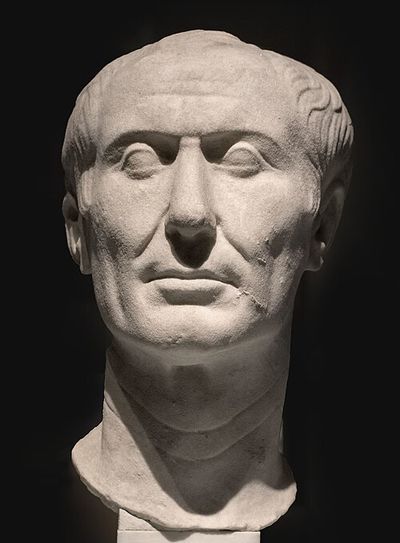
The exact words
“VENI · VIDI · VICI”Suetonius, Life of the Deified Julius 37, describing the placard carried in Caesar's Pontic triumph in 46 BC
✓ VerifiedFound in a primary source: the original book, speech transcript, letter or recording.
What people get wrong
Common reading
A battle cry Caesar shouted on the field.
A battle cry Caesar shouted on the field.
Closer to the original
It was a report written after the fight, and a boast about speed. The joke for Roman readers was partly that the war had been so easy it barely needed describing.
It was a report written after the fight, and a boast about speed. The joke for Roman readers was partly that the war had been so easy it barely needed describing.
Timeline
- 47 BCCaesar defeats King Pharnaces II of Pontus at Zela after a very short campaign. According to Plutarch, he reported the result to a friend in Rome in three words.
- 46 BCIn his triumph in Rome, the Pontic victory is marked by a sign bearing just “Veni, vidi, vici,” which Suetonius says stood out from the other displays.
- c. AD 121Suetonius records the placard in his biography of Caesar.
Use it in a speech
Julius Caesar summed up one of his fastest wins in three words: veni, vidi, vici. I came, I saw, I conquered. Let's give them nothing more to write about than that.
~10 secondsto say aloud
Pauseafter “three words”
Best spotthe end of the team talk
Caesar's report from Zela, “veni, vidi, vici,” is perhaps the most famous example of saying a great deal with almost nothing.
~7 secondsto say aloud
Pausenone needed in writing
Best spotopening sentence
Questions people ask
What does veni, vidi, vici mean?
“I came, I saw, I conquered.”
Who said veni, vidi, vici?
Julius Caesar, about his victory over Pharnaces II at Zela in 47 BC.
Why is it so famous?
The three verbs sound alike, they are short and they move from arrival to victory with no wasted words. It is a textbook example of the rhetorical pattern called a tricolon.
How do you pronounce it?
In classical Latin it is roughly “WAY-nee, WEE-dee, WEE-kee.” Many English speakers say “VEH-nee, VEE-dee, VEE-chee,” following church Latin.
Cite this quote
These cite the original text directly, so you can use them in an essay or paper. Always check your teacher's required style.
MLACaesar, Julius. Report of his victory at Zela, later shown in his Pontic triumph. 47 BC. The Latin Library, www.thelatinlibrary.com/suetonius/suet.caesar.html.
APACaesar, J. (47 B.C.E.). Report of his victory at Zela, later shown in his Pontic triumph. The Latin Library. https://www.thelatinlibrary.com/suetonius/suet.caesar.html
CHICAGOJulius Caesar, Report of his victory at Zela, later shown in his Pontic triumph, 47 BC.
IN TEXT (APA)(Caesar)