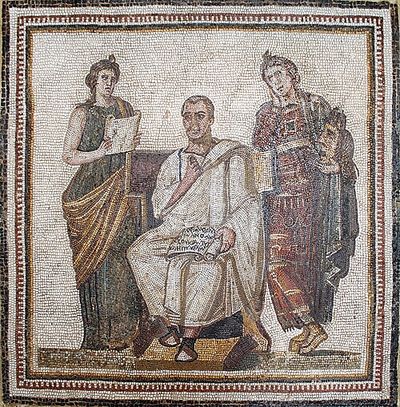
The exact words
“Sed fugit interea, fugit inreparabile tempus.”Virgil, Georgics 3.284 (“But meanwhile it flees, time flees beyond recall”)
≈ ParaphraseThe idea is genuine, but the popular wording is not what was actually said or written.
What people get wrong
Common reading
A light remark that time passes quickly.
A light remark that time passes quickly.
Closer to the original
Virgil's line is more serious. The key word is “inreparabile”: time that cannot be repaired or won back. It is a reminder to use time well, not just a comment on how fast it goes.
Virgil's line is more serious. The key word is “inreparabile”: time that cannot be repaired or won back. It is a reminder to use time well, not just a comment on how fast it goes.
Timeline
- c. 29 BCVirgil finishes the Georgics, a long poem about farming. In Book 3, on raising animals, he catches himself lingering on details and notes that time is slipping away.
- Middle Ages onwardThe short form “tempus fugit” becomes a stock motto, later engraved on sundials, church clocks and grandfather clocks.
- TodayIn English, “time flies” is used almost cheerfully, as in “time flies when you're having fun.”
Use it in a speech
There's a Latin motto on old clocks, tempus fugit, time flies. Twenty-five years at this company flew by for us too, and we're grateful we got to spend them with you.
~11 secondsto say aloud
Pauseafter “time flies”
Best spotjust before the toast
Virgil's warning that time flees “beyond recall” has been carved on clocks for centuries, yet we still behave as if hours were endlessly renewable.
~9 secondsto say aloud
Pausenone needed in writing
Best spotopening sentence
Questions people ask
What does tempus fugit mean?
“Time flees” or “time flies.”
Who said tempus fugit?
It comes from the Roman poet Virgil. In Georgics 3.284 he wrote “fugit inreparabile tempus,” time flees beyond recall. The two-word version is a later shortening.
Why is tempus fugit on clocks?
Clockmakers and sundial makers liked short Latin mottoes about time, and this one fit perfectly. Memento mori was another favorite.
How do you pronounce it?
Usually “TEM-pus FEW-jit” in English, or “TEM-pus FOO-git” in classical Latin.
Cite this quote
These cite the original text directly, so you can use them in an essay or paper. Always check your teacher's required style.
MLAVirgil. “Georgics.” Book 3, line 284. c. 29 BC. The Latin Library, www.thelatinlibrary.com/vergil/geo3.shtml.
APAVirgil. (29 B.C.E.). Georgics. The Latin Library. https://www.thelatinlibrary.com/vergil/geo3.shtml
CHICAGOVirgil, “Georgics,” Book 3, line 284, c. 29 BC.
IN TEXT (APA)(Virgil)